
In the past, I have written about how to establish a shrine and how the objects on the shrine can be anchor points. I gave a brief overview of the different parts in the initial blog and a practice for devotion. In this blog, I am going to be writing about the different parts of the shrine and the meaning they have for the Deity involved.
A shrine is different from an altar in that an altar is built with the intention to do workings at it. Practices are done around an altar and a Deity is not truly focused on at it. A lot of people tend to conflate the two of them and have a plethora of objects around the altar for a Deity while it is not being used strictly for a Deity.
For purposes of invocation, offerings, and other devotional acts, a shrine is essentially a home of a Deity. It is where the landing point is within the home for the Deity to arrive in, take offerings, be spoken to, among other workings. It can also be used to charge objects as I described before as anchors for that Deity like devotional jewelry or anything else that can be used to be carried around.
These things are the most important aspects of a shrine and should be used in the very least.
A candle
A candle is an activation point for the energy. It is as though someone would light a beacon for the Deity to see in the dark and lures the Deity towards the shrine. Because Deities do not have eyes or anything else that would otherwise impart a physical attribute to Them, energy is the main point of contact for a Deity to us. Anything involving energy like fire is the easiest way to bring a Deity forth. It is not an automatic assumption that a Deity would be inclined to be at the altar once the candle is lit – that sort of thing can take time to build rapport with the Deity as well as give Them a way to have interest in what is going on there.
A candle can be anything – tea light, jar candles, scented candles, etc. They can be any array of colors or shapes – the simple act of lighting it is the main purpose and everything else is extra. You can have a candle that is a color that the Deity is known for or you liken Them to but it is not needed. Any candle will work for these purposes.
If a candle cannot be lit, you can look into getting an LED candle which would work essentially the same as energy is still being activated and used to guide the Deity close. A small LED tealight will do perfectly well that you can find at a dollar store.
Bowl/cup
A bowl is for offerings. Once the candle is lit, an offering can be placed into the bowl. Do not eat it, move it, or do anything until after the candle is extinguished and once it is extinguished.
Once the candle is extinguished, you can remove it and throw it away. Do not let your offerings sit out for longer than the candle is lit because the energy that was meant to be taken should have been taken by the time you blow it out or snuff it.
Your bowl should be kept clean and made sure dust doesn’t build up on it. If needed, you can place a paper towel for food offerings so you don’t have to keep cleaning it for food offerings.
In the same vein, libations can be poured into a glass and then emptied out the same moment that the candle is extinguished. Once the candle is extinguished, you can either drink the libation or pour it out in the sink. Be mindful when you pour out libations with alcohol outdoors because alcohol can disrupt the soil in your natural environment and create problems. If pouring out alcohol, be sure to use a stone or any other object that deters the alcohol from being poured straight into the ground.
Statue/Picture/Iconography
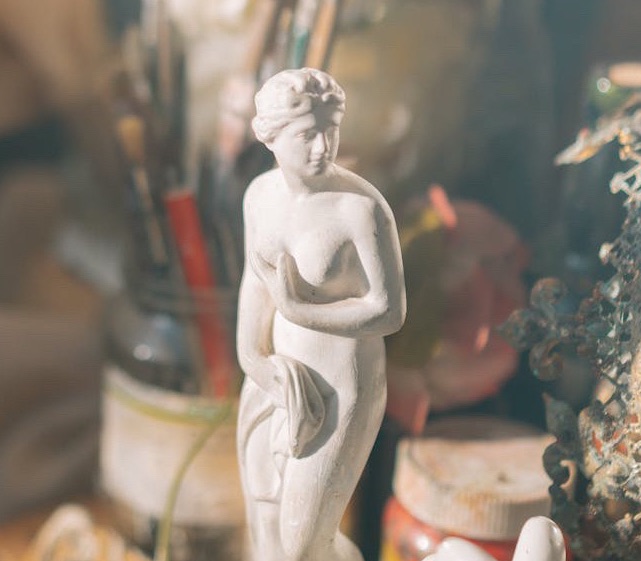
This is the last part of the shrine that is necessary for an occupied shrine. A picture, image, or statue of the Deity that is occupying the shrine ensures that you are able to have an image in your head of what They look like and that image is important for Them to use to relate to you by.
It would become essentially a physical representation of the Divine body on this realm even though the Divine do not necessarily occupy any sort of human form. However, the more you are able to relate to the Deity on the shrine, the easier it is for Them to manifest onto it. Images and statues hold power in the way that it is easier to relate yourself to the Deity and speak to Them, as well.
Otherwise, you’d be staring at an empty space and not exactly what is needed for best communication purposes.
Everything else
Everything else on the shrine would be at the Deity’s discretion. The Deity would need to allow the object placed on the shrine in order for it to be a permanent placement there. Otherwise, things such as amulets, jewelry, prayer beads, etc., can be placed on a nightly or daily basis in order to charge them with the Deity’s energy so the Deity can better anchor onto the object.
If you place anything there that is not what the Deity specifically requested, it becomes something that gets in the way of focus, meaning, and intent and therefore can create a blockage between you and the Divine inhabitant. Anything placed on the shrine should be kept clean and used as a focal point to what the offering or devotional act is used for.
Other objects a Deity might request are flowers, journals, writing, art, etc. and knickknacks should They prefer but it is important to also check with the Deity before moving the things on the shrine or placing objects to be charged there. Some objects are easier for Them to cling onto than others, and so what They prefer would be necessary.
As with all things, the more you use the objects on the shrine connected to the Being that inhabits it, the stronger and more impactful They can be to manifest the energy around the shrine. Energy needs to be built over time and the more you use a sacred place, the easier it is to create a point for the Divine to access and also for you to access Them.
The more objects on the altar there are, the less powerful it can be to create that sort of energy. It can be a bit off putting for the Deity to have things on the shrine that are not Theirs explicitly given and accepted.
For example, a lot of people feel that Loki is a “trash goblin” and He would prefer to have His shrine reflect that but that is far from true. Just like any Deity, anything that deters from the true intention of the location would be in the way for Him to access this world and most importantly access the devotee who comes to the shrine. If you are unsure of what should be left on the shrine, you can take it apart and use your intuition to place the objects back onto the shrine. If they aren’t meaningful to you, then it’s likely it won’t be meaningful to Them, either. Leave the trinkets and toys off the shrine unless they specifically are requested to be put back.
It is a show of respect and acknowledgement to maintain a clean, simple shrine, so that no objects can get in the way between you and the connection you want to create with Them. It is also important to note that the space you are creating is Their home within your home. You can’t just come in unannounced or unwarranted and you don’t want it to get ruined, dirty, or neglected. If you cannot keep up with a shrine, take it down and consider other methods that I have stated in prior posts regarding shrine establishment.
It is not a moral imperative whether or not you take care of the shrine, it is more like knowing you are respecting the Divine you are working with and you are showing hospitality to Them as They would to you and acknowledge Their place in the world within your home.

 Devoured by Flame
2 responses to “Parts of a Shrine”
Just wanted to add an alternate view regarding statues/pictures. Not that I think you’re wrong, of course, and obviously having a cult image is an ancient and widespread tradition. BUT… I don’t think it is required, as aniconic worship also has much precedence. And not only that, but sometimes those images can get in the way.
Any image we have in our heads of the divine is by definition limited, and limiting. We picture a god with dark hair, or certain clothes, or the head of an animal…these can all say something meaningful about Their nature but they can also freeze our understanding of Them into one form (or, as having form at all). Yes, it does make it easier to relate to Them, especially initially. But after a certain point, whether one keeps icons or not, one ideally moves deeper into a conception of, and relation to, that deity which does not rely on visual manifestations. There are other ways of sensing, and experiencing, divine presence, and sometimes our reliance on familiar shapes can get in the way of those.
In fact, I would argue that “staring at an empty space” is an *excellent* way to get into the receptive state of mind necessary for divine communication. Not the *only* way, of course, but a very valid and time-tested one.
That all being said, I personally do employ images on most of my shrines. However, I tend to have a multitude of varying images displayed together, so that my impression of Them does not ossify in only one of Their many masks.
LikeLike
Thank you, Dver, for your words. It made me think about things a bit more closely and re-explain it at a different angle so I arrived at the following conclusion:
It’s not that the shrine “requires” an icon, but rather, that it’s likely that most practitioners do not have enough of an anchor on their shrine for the Deity to cling onto and it’s important to not just assume that’s the case for all people. An icon is created in a way that it is an optimal anchor for the Divine to manifest with and given that, it’s much easier to be able to define the presence of a God more naturally rather than it be up in the air and abstract.
I suppose I’m looking at it from a two-way perspective, one in which the Deity reaches towards us and requires certain conditions to get there and the other in which the devotee needs to reach back to the Deity and create that sort of guiding light to their shrine for the Deity to manifest.
I also suppose, given that most may not know how well a Deity can hold onto the shrine they have, that asking the Deity in question what They need to make that happen rather than just assuming They don’t need one and going from there. I can’t speak for all Gods and practices and deity relationships, but this is more or less a foundational part for a beginner rather than someone who has had multiple years of solid practice.
Thank you again for your thoughts, though, and making me rethink how I explain some things.
LikeLike